What is CPaaS?
If you’ve ever wondered how companies send millions of SMS messages, enable in-app calling, or automatically notify customers about their orders, CPaaS is often the driving force behind these capabilities.
Here’s our explainer on what CPaaS is, how it works, and why businesses are leveraging it.
CPaaS meaning
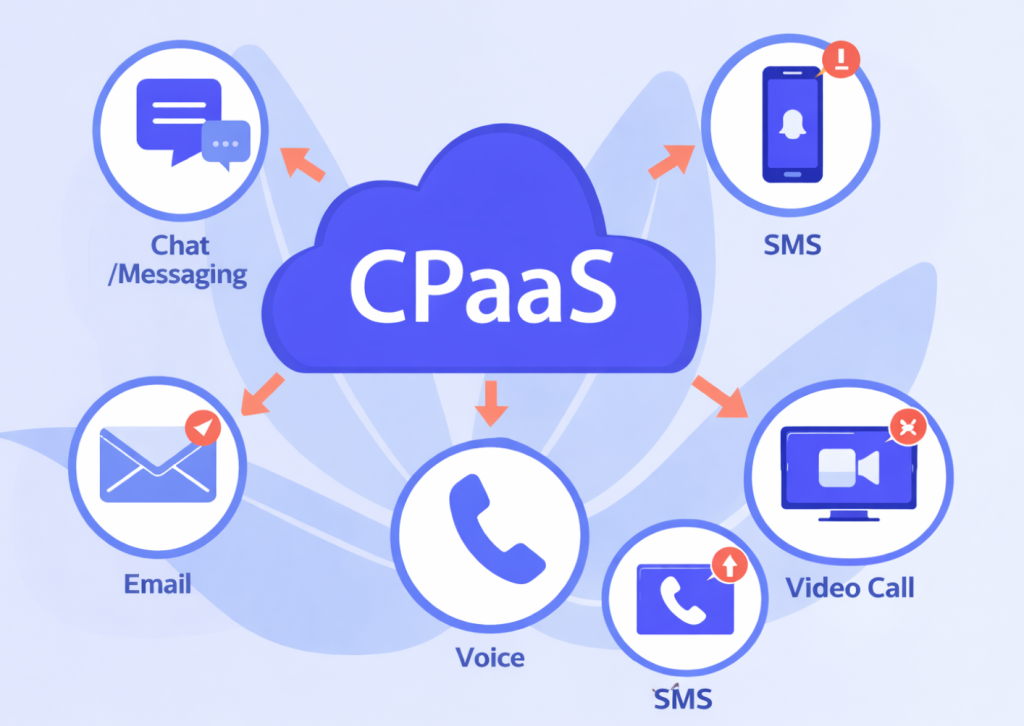
CPaaS (Communications Platform as a Service) is a cloud-based platform that enables businesses to integrate communication capabilities into their products and workflows via APIs. Simply put, instead of building their own telecom infrastructure, companies connect to an existing platform and use it to send SMS messages, make calls, deploy voice bots, run messaging campaigns, and send email notifications.
With CPaaS, businesses can embed communications directly into their websites, applications, or CRM systems. For instance, an online store might automatically send SMS updates about order status, a fintech service could verify logins with an OTP code, and a delivery service may provide voice notifications to customers. All of this is achieved through API integrations with a CPaaS provider.
It’s essential to note that CPaaS isn’t a standalone user interface. It serves as infrastructure. The business defines the logic, scenarios, and customer touchpoints, while the platform takes care of message delivery, traffic routing, scalability, and reliability. Typically, companies pay based on usage (such as the number of call minutes used or messages delivered across different channels).
How does CPaaS actually work?
CPaaS operates via APIs – software interfaces that connect your system to a provider’s communications infrastructure. When an event occurs in your business process (for example, a customer places an order or requests a confirmation code) your system sends a request to the CPaaS platform. The platform processes the request and delivers the message through the appropriate channel: SMS, voice call, messaging app, or email.
The CPaaS provider is responsible for connecting to telecom operators, routing traffic, validating phone numbers, ensuring delivery performance, maintaining backup routes, and complying with local regulations.
Typical process flow
- Developers integrate the CPaaS API into your system.
- They configure communication scenarios (defining when and to whom messages should be sent).
- The platform automatically scales based on traffic volume.
- If communication volume spikes—such as during a promotion or large campaign—the CPaaS platform distributes traffic across available routes. Should one channel become unavailable, the system can switch to a backup route seamlessly.
Why do businesses need CPaaS?
Businesses leverage CPaaS to manage customer communications in a scalable and efficient manner. Today, messaging is integral to the product experience—covering registration confirmations, order updates, payment reminders, delivery notifications, and two-factor authentication. Unreliable or unscalable processes can directly impact customer experience and revenue.
Operational integration. CPaaS enables businesses to embed communications directly into their operational workflows. Instead of relying on manual messaging or disconnected tools, companies gain a unified infrastructure layer that executes predefined logic automatically — at the right moment and through the right channel.
Scalability. As a business grows, communication volume increases rapidly: more orders, more users, more notifications. Building and maintaining telecom infrastructure in-house is costly and complex. CPaaS addresses this through a pay-as-you-go model and a pre-built network of carrier and messaging connections.
Flexibility. Companies can test and deploy new communication scenarios — such as voice bots, messaging app integrations, or omnichannel workflows — without rebuilding their core product. These capabilities are enabled through APIs and can be adapted as business needs evolve.
Control and visibility. Modern CPaaS platforms provide detailed delivery reports, message statuses, performance metrics, and webhooks for automated event handling. This allows businesses not only to send messages, but to manage communications as a measurable and strategic part of growth.
CPaaS helps businesses easily integrate communications into their products and processes, eliminating the need to build their own telecom networks.
For some companies, CPaaS provides a quick way to send notifications and OTP authentication. For others, it serves as the foundation of a multi-channel strategy with automated workflows and integrations. In both cases, the value of CPaaS lies in making communications manageable, scalable, and predictable.
We firmly believe that Massiva is the best CPaaS provider because it makes adding communication features easy for businesses.
With a simple API, companies can send SMS messages, make calls, and use messaging tools without needing their own telecom systems. Massiva’s pay-as-you-go plan means businesses only pay for what they use, making it affordable and scalable.
Plus, our strong customer support helps businesses feel confident in their communication. With useful analytics and customizable options, Massiva helps companies grow and succeed.