History of RCS messaging: when did RCS come out?
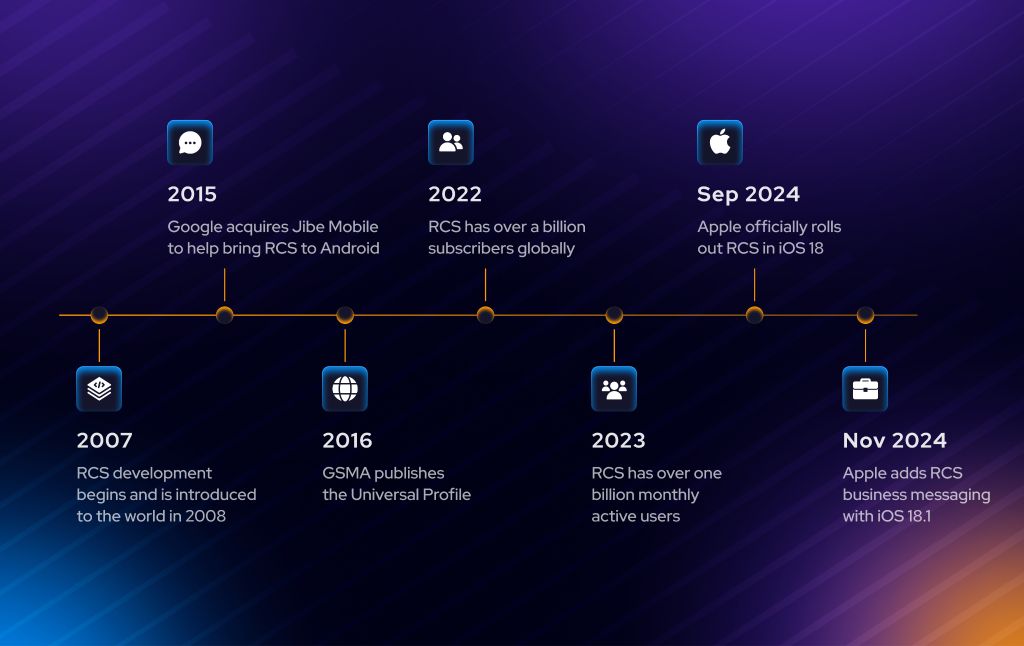
Rich Communication Services (RCS) emerged from the idea of improving traditional SMS by adding modern features similar to those found in popular chat applications. From its start in 2007 as a creative concept to its widespread use today by billions of people, RCS illustrates how collaboration and innovative technology can greatly enhance communication.
The origins of RCS (2007–2010)
In 2007, a group of mobile network operators and technology providers came together with the vision of creating Rich Communication Suite, which was later renamed Rich Communication Services.
Their goal was to incorporate advanced features like file sharing, location information, and video calling into mobile messaging, all made possible through a system called the IP Multimedia Subsystem (IMS).
The GSM Association (GSMA) took over the project in early 2008 and released the first official guidelines for RCS on September 15, 2008. Unfortunately, early versions faced many challenges, including varying implementations and the need for separate applications, which made it difficult for users to adopt the technology.
Joyn and the first deployments (2011–2014)
To make RCS feel more accessible to consumers, the GSMA launched the Joyn brand in 2011. European companies like Vodafone and Orange began promoting Joyn-enabled devices that featured functions such as file sharing and video calls.
In the United States, MetroPCS also offered the service under the Joyn name. Moreover, Apple introduced iMessage for its iPhone, which drew attention away from Joyn.
However, Joyn struggled to gain traction because many devices required separate apps, leading to confusion for users. Despite an update in 2012 known as RCS‐e aimed at improving the service, interest in Joyn did not increase.
Cloud hubs and the Universal Profile (2014–2016)
A turning point arrived when Jibe Mobile, a startup, developed a cloud hub that allowed different mobile operators to connect their RCS platforms more effectively. In September 2015, Google acquired Jibe and integrated its technology into Android Messages, making it easier for users to send RCS messages.
In 2016, the GSMA and Google introduced the Universal Profile, which provided a common set of rules that all devices and networks could follow. This standardization helped eliminate many compatibility issues, allowing carriers to roll out RCS more widely and seamlessly.
Growth and business messaging (2017–2021)
Between 2017 and 2021, the use of RCS continued to grow steadily. Google included RCS in Android Messages, and by early 2020, ninety mobile operators across sixty countries were offering the service.
In the U.S., major carriers like AT&T, Verizon, and T-Mobile decided to use Google Messages instead of their own messaging systems, which resulted in a broader adoption of RCS.
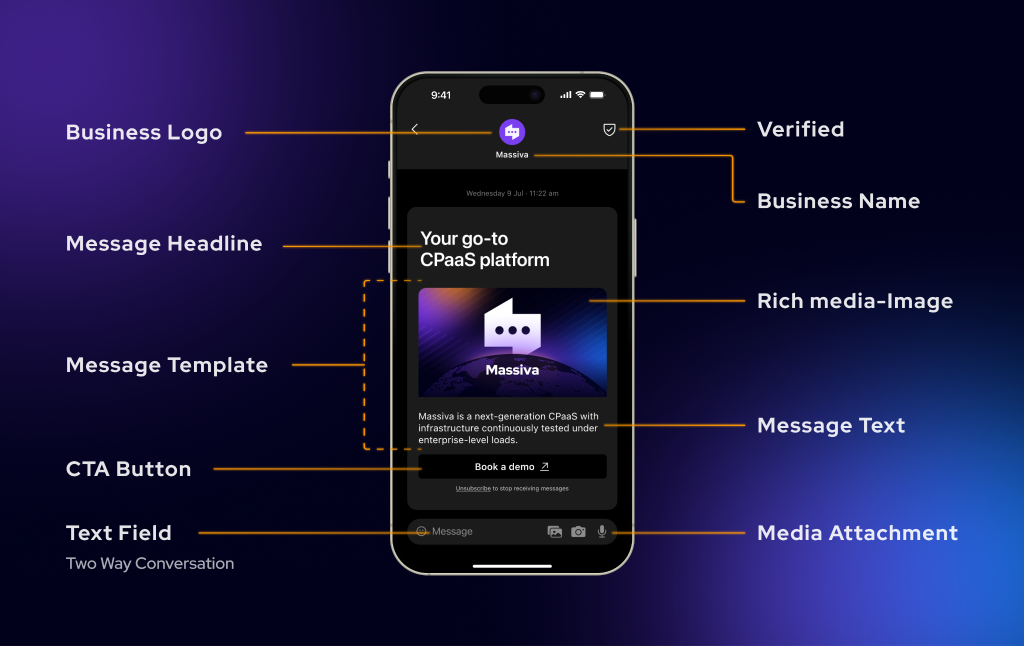
The introduction of the Universal Profile also made it easier for businesses to use RCS for Business Messaging, enabling brands to send interactive and engaging messages, complete with options like clickable buttons and product carousels. Many companies, including retailers and banks, quickly recognized the value of RCS for important customer notifications and engaging marketing campaigns.
A billion users and Apple’s pivot (2022–2024)
By 2022, RCS had gathered a significant user base, reaching over one billion users.
A major shift also occurred in November 2023 when Apple announced that the upcoming iOS 18 would support RCS. This feature rolled out in September 2024, allowing iPhone and Android users to send rich messages to each other easily.
In markets like France, where Android is dominant, more than 85% of smartphones began supporting RCS. In certain regions of Germany, RCS even surpassed WhatsApp in terms of coverage.
Apple’s entry into the RCS landscape also diminished a significant barrier, making it much easier for users across different platforms to connect.
The current landscape (2025–2026)
By 2025, industry experts estimated the global RCS market to be worth approximately $3 billion, with expectations for it to grow to $9 billion by 2030. The volume of business messaging is projected to skyrocket, moving from 33 billion messages in 2024 to 50 billion in 2025, eventually hitting 200 billion by 2029.
For example, in France, by the end of 2025, over 421 brands were actively running RCS marketing campaigns, which is 2.5 times more than just the previous year. This rapid growth underscores how businesses are beginning to realize the benefits of this new communication channel.
What RCS offers beyond SMS
RCS messages stand out for their added capabilities compared to traditional SMS. Unlike SMS, which has strict limits, RCS messages can include longer texts, images, and other media files up to 10 MB.
They allow for interactive options, like reply buttons, and verify who the sender is, making them more trustworthy.
RCS also provides delivery and read receipts, giving businesses valuable insights into how well their messages are being received.
Additionally, Google has introduced end-to-end encryption for added security, and Apple intends to implement the same security features, ensuring safe communications between users.
Business success stories
Many companies have reported impressive results from their RCS campaigns:
- Picard, a French frozen food retailer, sent out promotions during the holidays via RCS, resulting in a significant 42% increase in customer engagement. They also tripled their click-through rates and saw 10% more traffic to their website.
- Printemps, a well-known department store, achieved a strong 75% read rate with RCS, tripling the number of visitors redirected to their website. They also significantly increased downloads of their loyalty card through RCS marketing efforts.
- Clarins, a cosmetics company, ran two successful campaigns using RCS. The first campaign recorded a 79% read rate and a 22% click-through rate, while the second campaign had a 76% read rate and an 11% CTR, showcasing impressive results compared to similar campaigns using SMS.
- BUT, a furniture retailer, saw a 13.3% click-through rate, doubled their return on investment, and expanded their WhatsApp opt-in list by 123% as a result of their RCS initiatives.
These success stories demonstrate that RCS can generate higher engagement and return on investment compared to traditional marketing methods, often yielding better results than email and mobile ads. Analysts indicate that open rates can reach impressive levels, sometimes as high as 98%, while conversion rates can hit up to 50%.
Challenges and the path ahead
For RCS to function smoothly across different mobile networks, operators need to work together and integrate their messaging systems with Google’s Jibe hub. Some smaller carriers are still catching up to the trend, and smartphone manufacturers must ensure that new devices come equipped with compatible RCS apps. Regulations, such as those in China requiring all 5G smartphones to support RCS, have also significantly sped up adoption rates among users. Google’s ongoing efforts in maintaining security and Apple’s support are important steps toward addressing user privacy concerns.
Looking forward, experts believe that RCS has the potential to lay the groundwork for more interactive shopping experiences. This platform enables users to browse products, place orders, and even manage returns straight from their messaging apps. I
Juniper Research anticipates that revenue from rich business messages powered by RCS will grow dramatically, from around $2 billion in 2026 to $6.5 billion by 2030.
And, as more brands harness the possibilities of RCS, it is becoming an essential tool for marketing, customer service, and transactions.
Looking ahead
In 2026 RCS becomes mainstream, not experimental.
Forward‑thinking brands must combine SMS for reach, speed, and ubiquity with RCS for interactivity and visual storytelling, delivering higher engagement, satisfaction, and revenue while keeping SMS’s simplicity.
Whether you’re a retailer personalizing promotions, a sports team engaging fans, or a service org improving support, RCS adds new possibilities when layered onto existing text programs. The shift takes planning, but the payoff is clear.
SMS remains essential for mission‑critical alerts and broad reach. What changes in 2026 is that RCS becomes a practical tool to build deeper customer relationships by letting users choose either simple texts or immersive conversations.
Elevate your marketing with Massiva
Looking to enhance your SMS marketing strategy? Massiva is a powerful CPaaS (Communications Platform as a Service) designed to simplify and supercharge your messaging campaigns.
Why choose Massiva?
- Easy integration. Quickly connect Massiva to your existing systems for seamless communication.
- Robust SMS capabilities. Send personalized, high-impact SMS messages that reach your audience instantly.
- High open rates. Benefit from the proven effectiveness of SMS marketing with nearly 98% open rates.
- Two-way communication. Engage in real conversations with your customers, enhancing support and building relationships.
- Data-driven insights. Analyze performance and optimize campaigns with powerful analytics tools.
With Massiva, you can turn SMS into a massive game-changer for your marketing efforts. Elevate your customer engagement and drive conversions with targeted, impactful messaging. Discover how Massiva can transform your SMS marketing today!