How to switch from SMS to RCS in 2026
Why look beyond SMS
Mobile marketing started with SMS, and SMS remains a core channel: universal, fast, works on every phone, and doesn’t need data. It’s ideal for time‑sensitive alerts and simple notifications. But SMS’s 160‑character limit and plain‑text format can hold back campaigns that need interactivity or visual storytelling. Consumers now expect personalized, app‑like experiences on their phones, and brands that deliver tend to see better results.
A 2026 e‑commerce report found RCS (Rich Communication Services) drives 300-700% higher conversion rates than traditional SMS. RCS combines SMS’s reach with app‑style interactivity, such as carousels, video, quick‑reply buttons, and branded sender IDs. Open rates often top 90%, click‑throughs can be three to seven times higher than SMS, and conversions frequently exceed 80%.
RCS adoption is accelerating. Apple adding RCS support in iOS 18 pushed daily RCS traffic in the U.S. past a billion messages. Adoption is also strong across Europe, Latin America, and India where carriers already support RCS. Rather than replacing SMS, RCS is a complementary channel that helps marketers stand out in crowded inboxes while keeping the ubiquity and reliability of text messaging.
RCS vs. SMS. What’s the difference?
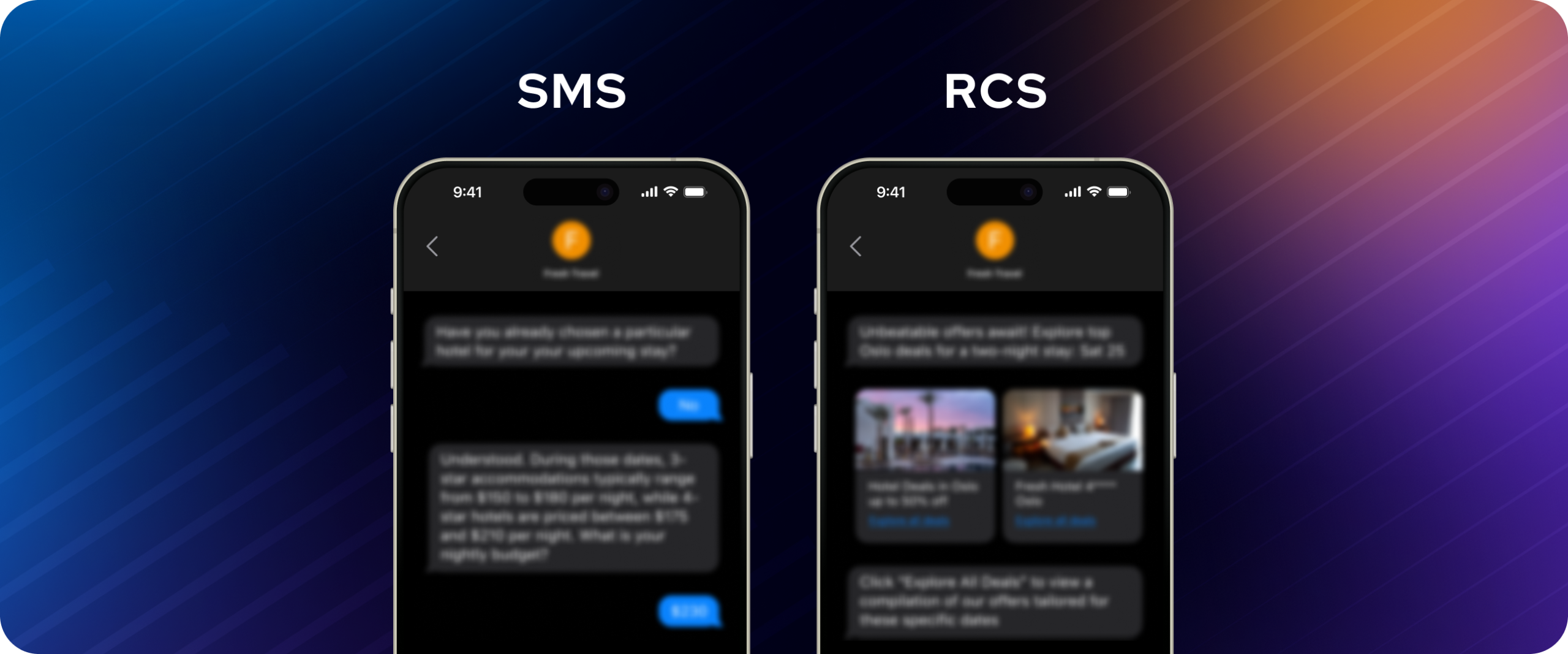
RCS upgrades the humble text message in several ways.
- Branded verification. Messages show your brand name, logo, and verified badge, which reduces phishing risk and opt‑outs.
- Rich media. RCS messages use carousels, images, videos, and CTAs instead of plain text.
- Two‑way interaction. Quick‑reply buttons let customers ask questions, book, or check order status inside the thread. Brands using RCS for support report ~40% faster issue resolution and ~25% fewer support tickets.
- Analytics. Marketers can track reads, replies, and link clicks, enabling real‑time optimisation.
SMS still continues to play an essential role in your toolkit. It’s cost‑effective, boasts near‑perfect deliverability, and reaches users regardless of device, data plan, or operating system.
SMS is ideal for account alerts, one‑time passwords, and urgent announcements. RCS should be viewed as a complement when you want to add richer media or conversational flows.
Many brands run A/B tests to compare SMS and RCS and find that both channels can work well depending on the audience and goal. With that mindset, the stories below illustrate how companies enhanced their existing SMS programmes by adding RCS features.
Tip: Treat RCS as a complement to SMS when you need richer media or conversational flows. Run A/B tests: some audiences and goals perform better on SMS, others on RCS.
Success Stories: How adding RCS improves the outcomes
Picard. Personalising the holiday menu (Retail)
Picard, the French frozen‑food retailer, wanted to make its holiday promotions more engaging. It used RCS to build an interactive journey in which customers chose preferences such as budget and dietary needs and received personalized menu suggestions.
The campaign delivered a 42% increase in engagement and 3x higher CTRs than Picard’s previous rich‑SMS campaigns, plus 10% more web traffic. By guiding shoppers through options inside the message, Picard turned a seasonal promotion into a personalized shopping assistant.
Micromania‑Zing. Gamifying holiday shopping (Gaming & retail)
French gaming retailer Micromania‑Zing adopted RCS for its holiday campaign. Messages contained suggested replies and guided shoppers through product selection.
Compared with email newsletters, Micromania‑Zing’s RCS campaign achieved an 86% higher read rate and a seven times higher click-through rate. The ability to keep gamers inside the conversation, rather than directing them to a website, drove both engagement and sales.
Clarins. Boosting beauty campaigns (Cosmetics)
Skincare brand Clarins used RCS to promote seasonal offers, pairing a branded sender profile with interactive visuals and CTAs. The RCS campaign achieved a 79% read rate and a 22% click‑through rate, roughly double the CTR of the company’s previous rich‑SMS promos. Clarins leveraged verified branding and interactive cards to make promotions feel like personalised consultations rather than unsolicited ads.
LA Rams. Bringing fans closer (Sports & entertainment)
At the Google RCS World Tour, the Los Angeles Rams shared how switching from traditional SMS to RCS transformed fan engagement. In one campaign, supporters could browse upcoming games, purchase tickets, and receive personalized updates entirely within the message thread. The team reported a 70% increase in engagement and a 60% lift in revenue after moving to RCS. Fans embraced the frictionless experience of buying and interacting without leaving their messaging app.
United Airlines. Conversational customer service (Travel)
United Airlines shifted about 30% of its customer contacts to RCS messaging and observed customer‑satisfaction scores 10 points higher than on other service channels. Travellers can rebook flights, request updates, or resolve issues in a single thread. This conversational approach reduces wait times and improves loyalty.
Fintech Provider. Streamlining customer service (Financial services)
A US‑European financial services provider partnered with Master of Code to unify its communications across RCS and SMS. By building an RCS Business Messaging platform with SMS fallback and intelligent routing, the company delivered real‑time account updates and routed queries to the right department. Within six months, the initiative achieved a 42% reduction in customer service calls, a 94% read rate for critical notifications, 300% faster issue resolution, and a 27% increase in satisfaction scores. It also cut client‑reported frustration by 64% and saved $1.2 million annually in call‑centre costs. RCS with SMS fallback can drastically improve support efficiency without sacrificing reach or compliance.
AETNA. Streamlining prescription reminders (Healthcare)
Pharmacy giant’s CVS Health subsidiary Aetna used RCS to send prescription reminders and health alerts. After switching, the company saw a 40% decline in opt‑outs and increase in engagement, illustrating that RCS can enhance compliance and trust in regulated industries.
These stories demonstrate that richer messaging drives measurable business outcomes across retail, gaming, beauty, sports, travel, and healthcare.
How to switch from SMS to RCS
Assess technical readiness.
Check device and OS support.
RCS works natively on Android (Google Messages) and on iPhones running iOS 18+.
Ensure your test devices and early adopters meet these requirements.
Verify carrier availability.
Carriers must enable RCS on their networks. Major operators such as Vodafone, Orange, T‑Mobile, and AT&T support RCS, but coverage varies by region. Roll out first in markets with strong adoption (US, European Union, Latin America, India).
Turn on RCS for end users.
Once device and carrier requirements are met, users simply enable RCS in their messaging app.
On Android, they should open Google Messages, go to Messages Settings → RCS chats, and toggle it on.
On iPhones (iOS 18+), they should go to Settings → Apps → Messages → RCS Messages. Verification takes a few minutes and requires a phone number check.
Prepare your business for RCS.
Switching from SMS to RCS is a phased strategy, not a one‑time flip. Start by studying market readiness: run a market analysis to map where RCS is widely adopted and which customers have RCS‑capable devices.
- Study market readiness. Conduct a market analysis to understand where RCS is widely adopted and where customers have RCS‑capable devices. For non‑RCS‑capable numbers, messages can automatically fall back to SMS or other channels.
- Register as a verified sender. RCS business messaging requires a verified sender ID. Platforms like Infobip offer a portal that guides you through creating your RCS sender profile, uploading your logo, and testing rich cards and carousels. Without verification, you cannot send RCS messages.
- Manage consent and compliance. Existing SMS opt‑ins generally remain valid for RCS, but recipients must always have a clear way to opt out. Avoid disallowed content (e.g., tobacco, counterfeit goods, and political messaging), and follow file‑size limits for images and videos.
- Integrate RCS into your omnichannel stack. RCS should complement other channels. API platforms let you direct SMS, email, WhatsApp, and RCS from a single interface. Intelligent routing ensures that if a user cannot receive RCS messages, they still receive a message via another channel.
- Design campaigns for interaction. Use high‑quality media, interactive buttons, and carousels to create app-like experiences. Personalize messages based on customer data, and time campaigns to align with user behaviour. For example, RCS abandoned‑cart reminders can recover 35% of carts compared with 15% via email, while personalized offers produce higher conversion rates.
- Measure and iterate. Track open rates, clicks, replies, and conversions. Compare performance with SMS to calculate ROI. Good RCS campaigns see open rates above 90%, read rates over 70%, and conversion rates that regularly exceed 80%.
Best practices for a smooth migration
- Start with a pilot. Run a small RCS campaign to a segment of your SMS subscribers and compare results. Use interactive surveys or holiday promos to gather quick feedback.
- Leverage personalization. RCS’s interactive features shine when messages are tailored. Picard’s personalised holiday menus and Clarins’s branded visuals illustrate the power of personalisation.
- Use RCS for more than marketing. Customer support, order tracking, and loyalty updates benefit from two‑way, rich messaging. United Airlines’ success shows how RCS can improve service metrics.
- Educate your audience. Not all customers know about RCS. Include a short instruction in your SMS campaigns explaining how to enable RCS on their phones.
- Plan for fallbacks. Always configure a fallback channel (SMS, email, or WhatsApp) to ensure that non‑RCS users receive your messages.
Considerations and limitations
While RCS upgrades basic texting with richer media and interactivity, there are cases where plain SMS or another channel remains the better choice.
Compatibility is the first constraint: RCS requires both the sender and recipient to have a compatible device, an active data connection and a carrier that supports the protocol. This dependency can severely limit functionality when messaging iPhone users (prior to iOS 18) or subscribers on networks that don’t support RCS. You should always plan for automatic SMS fallback for numbers without RCS support.
Security and privacy also differ. Apple explains that RCS messages are not end‑to‑end encrypted in its implementation, while Google notes that end‑to‑end encryption only applies when all participants use Google Messages with RCS enabled. Treat RCS like a “better SMS” rather than a secure chat, and avoid sending highly sensitive information like credit‑card numbers, social‑security numbers or medical data via RCS. For sensitive transactions, direct customers to secure portals and follow industry compliance standards.
Finally, RCS is designed for transactional updates and conversational marketing, not for emergency alerts or high‑volume blasting. Because device and network support varies, you can’t guarantee reach for critical, time‑sensitive messages; stick with SMS or voice for those needs. Similarly, high‑volume campaigns without explicit consent can trigger complaints and deliverability issues, so follow CTIA principles and honour opt‑out requests.
By understanding these limits and pairing RCS with SMS, you can harness rich messaging responsibly and maintain both reach and trust.
Looking Ahead
In 2026 RCS becomes mainstream, not experimental.
Forward‑thinking brands must combine SMS for reach, speed, and ubiquity with RCS for interactivity and visual storytelling, delivering higher engagement, satisfaction, and revenue while keeping SMS’s simplicity.
Whether you’re a retailer personalizing promotions, a sports team engaging fans, or a service org improving support, RCS adds new possibilities when layered onto existing text programs. The shift takes planning, but the payoff is clear.
SMS remains essential for mission‑critical alerts and broad reach. What changes in 2026 is that RCS becomes a practical tool to build deeper customer relationships by letting users choose either simple texts or immersive conversations.
Elevate your marketing with Massiva
Looking to enhance your SMS marketing strategy? Massiva is a powerful CPaaS (Communications Platform as a Service) designed to simplify and supercharge your messaging campaigns.
Why choose Massiva?
- Easy integration. Quickly connect Massiva to your existing systems for seamless communication.
- Robust SMS capabilities. Send personalized, high-impact SMS messages that reach your audience instantly.
- High open rates. Benefit from the proven effectiveness of SMS marketing with nearly 98% open rates.
- Two-way communication. Engage in real conversations with your customers, enhancing support and building relationships.
- Data-driven insights. Analyze performance and optimize campaigns with powerful analytics tools.
With Massiva, you can turn SMS into a massive game-changer for your marketing efforts. Elevate your customer engagement and drive conversions with targeted, impactful messaging. Discover how Massiva can transform your SMS marketing today!